Blog
AI in tenders: a double-edged revolution?

Artificial intelligence: opportunities and fears
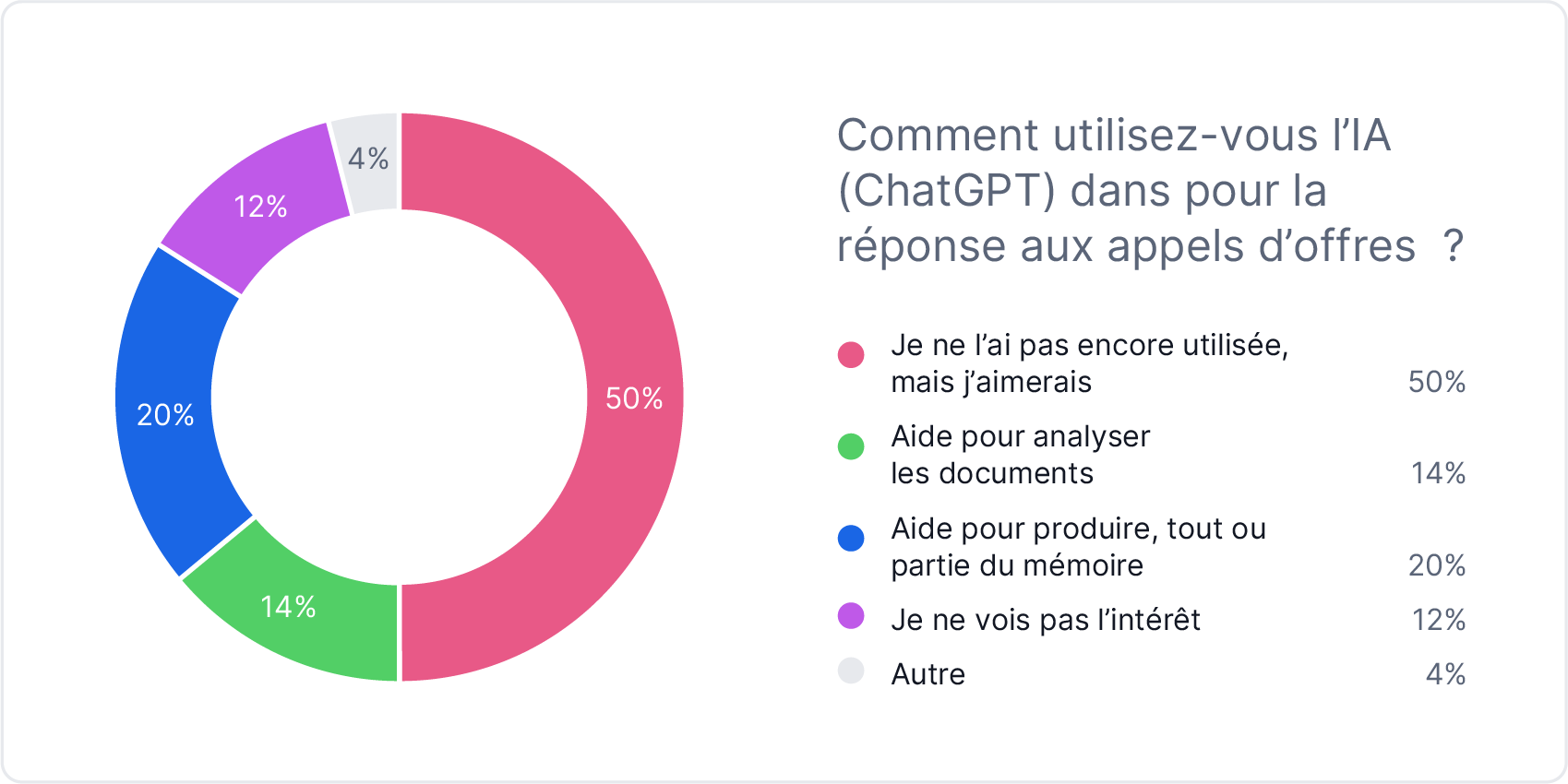
Tengo’s recent 2024 public procurement survey showed that 50% of companies have not yet adopted AI to optimize their tender responses, even though they are open to it. Only 12% of respondents are reluctant, seeing no value in such technology, while an equal proportion recognizes its potential, particularly for document analysis. Large companies express more reservations, with 19% of them doubting the usefulness of AI, perceived as a potential threat to jobs. Concerns about data security and confidentiality are particularly pronounced among these players, who often have more substantial means to manage their tender responses.
A new era for tenders
AI is transforming tender management, making opportunity analysis and response writing more efficient. Despite questions about the relevance of generated content and concerns about data confidentiality, these obstacles should not hold back the use of AI. On the contrary, they call for rethinking working methods to integrate this technology securely and productively.
AI and decision-making support
Thanks to its ability to analyze huge volumes of data, AI makes it possible to filter relevant tenders, detecting opportunities that might escape human analysis. OpenClassrooms, for example, reduced its tender analysis time from 2 hours to 5 minutes thanks to AI, by focusing only on the opportunities compatible with its business model.
AI and response generation support
AI also excels at assisting with proposal writing, precisely aligning the company’s offer with the buyer’s expectations. It draws on information about the buyer’s requirements and the company’s know-how to generate tailored responses, increasing the chances of success.
Beyond the generic: refining relevance with AI
Contrary to a common belief, AI-generated responses are not necessarily generic. The effectiveness of AI depends on the precision of the information and questions provided. Precision in how requests are formulated is crucial to obtaining relevant, personalized responses.
Navigating confidentiality challenges
Confidentiality is a major concern, expressed through questions about the choice of AI (local versus international) and the fear of information leaking to competitors. However, AI models, once trained, do not incorporate new data into their learning, thereby minimizing confidentiality risks.
The adoption of AI in tender response processes, although still timid, is shaping up to be an essential growth lever for companies. The challenges related to data confidentiality and integrity, while real, are not insurmountable and must be approached pragmatically.